Firewall
The Firewall allows you to view, add, edit, enable, disable, or delete Windows Firewall rules managed by NETworkManager. Rules are identified by a NETworkManager_ prefix in their display name so that only rules created through NETworkManager are shown in this view.
Windows Firewall (Windows Defender Firewall) is a built-in host-based firewall included with all versions of Windows. It filters inbound and outbound network traffic based on rules that define the protocol, port, address, program, and action (allow or block).
Without administrator privileges, the view is read-only. Use the Restart as administrator button to relaunch the application with elevated rights.
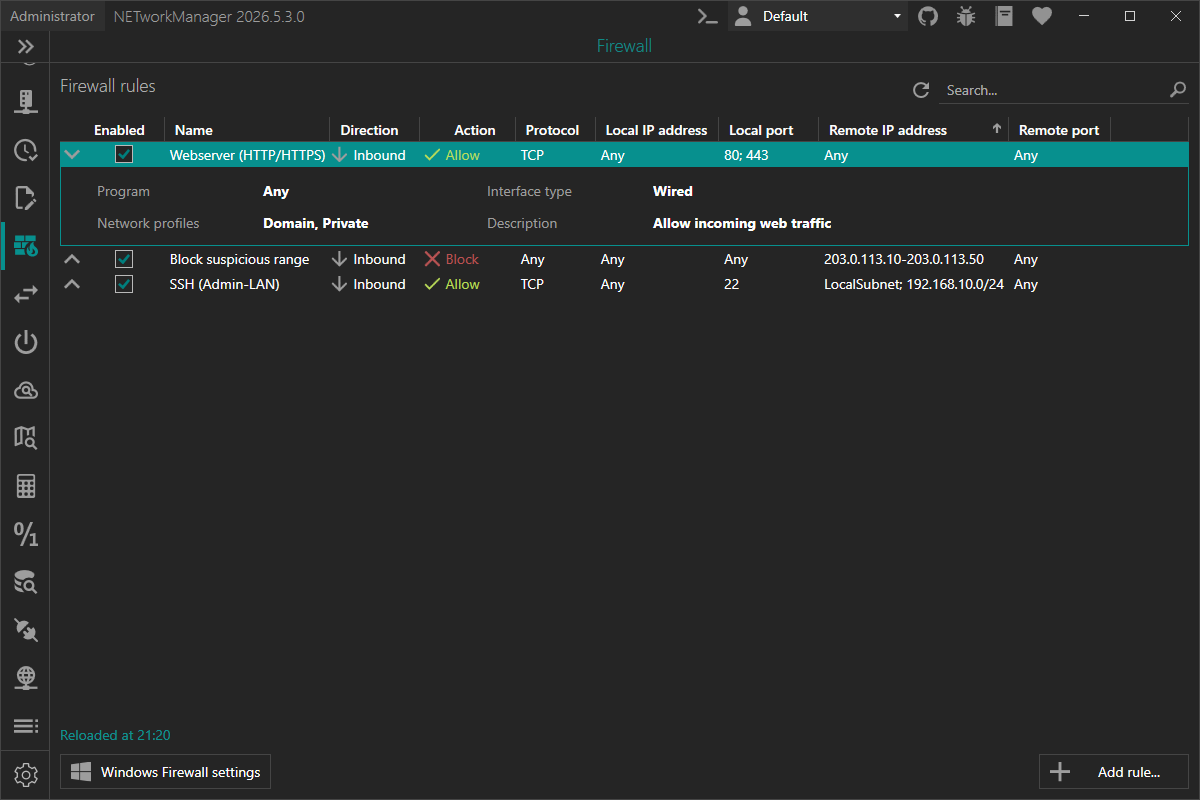
Toolbar
| Button | Description |
|---|---|
| Add rule... | Opens a dialog to create a new firewall rule |
| Windows Firewall Settings | Opens the Windows Firewall management console (WF.msc) |
Context menu
| Action | Description |
|---|---|
| Enable | Enables the selected rule |
| Disable | Disables the selected rule |
| Edit | Opens the edit dialog for the selected rule |
| Delete | Removes the selected rule |
| Copy | Copies the rule information to the clipboard |
| Export | Exports the rule to a file |
Keyboard shortcuts
| Key | Action |
|---|---|
F5 | Refresh |
F2 | Edit selected rule |
Del | Delete selected rule |
Add rule
The Add rule dialog is opened by clicking the Add rule... button below the rule list. The same dialog (with the values pre-filled) is used to edit an existing rule.
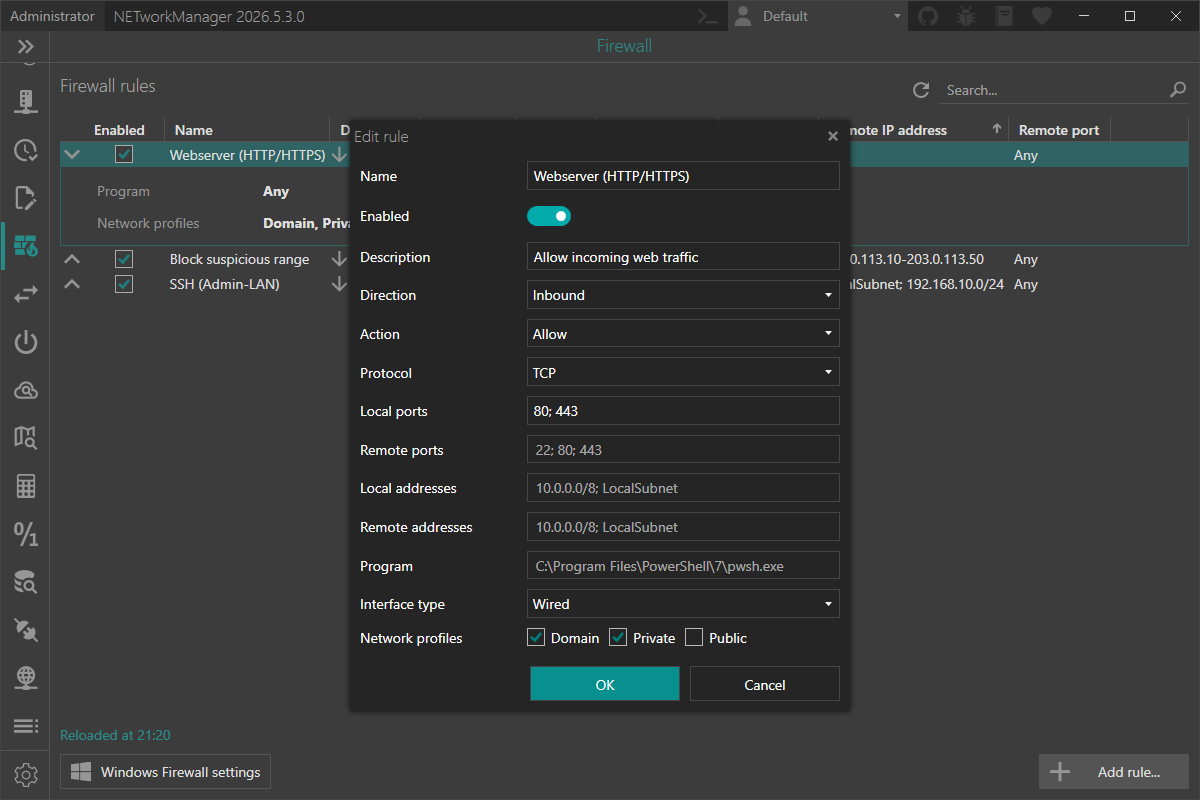
The display name of every rule created with NETworkManager is automatically prefixed with NETworkManager_ so it can be picked up by NETworkManager on the next refresh. The prefix is hidden in the user interface.
Name
Display name of the firewall rule.
Type: String
Default: Empty
Example: Webserver (HTTP/HTTPS)
The name is required and must not be empty. Internally the rule is stored with the prefix NETworkManager_ (e.g. NETworkManager_Webserver (HTTP/HTTPS)).
Enabled
Whether the rule is active right after creation.
Type: Boolean
Default: Enabled
Description
Optional description of the rule.
Type: String
Default: Empty
Example: Allow incoming web traffic
Direction
Traffic direction the rule applies to.
Type: NETworkManager.Models.Firewall.FirewallRuleDirection
Default: Inbound
Possible values:
Inbound(Traffic coming into the local computer.)Outbound(Traffic leaving the local computer.)
Action
Action that is performed when a packet matches the rule.
Type: NETworkManager.Models.Firewall.FirewallRuleAction
Default: Allow
Possible values:
Allow(Permit matching traffic.)Block(Drop matching traffic.)
Protocol
Network protocol the rule applies to.
Type: NETworkManager.Models.Firewall.FirewallProtocol
Default: Any
Possible values:
AnyTCPUDPICMPv4ICMPv6GREL2TP
Local ports and Remote ports are only available when the protocol is set to TCP or UDP.
Local ports
One or more local ports or port ranges the rule applies to. Multiple entries are separated by ;.
Type: String
Default: Empty
Example:
8080; 4438080-809027015-27030; 27036
Only available if Protocol is set to TCP or UDP.
An empty value means Any port.
Remote ports
One or more remote ports or port ranges the rule applies to. Multiple entries are separated by ;.
Type: String
Default: Empty
Example:
5380; 44349152-65535
Only available if Protocol is set to TCP or UDP.
An empty value means Any port.
Local addresses
One or more local addresses the rule applies to. Multiple entries are separated by ;.
Type: String
Default: Empty
Example:
192.168.1.10fe80::1192.168.1.0/2410.0.0.0/255.0.0.0192.168.1.10-192.168.1.50LocalSubnet; 192.168.10.0/24
An empty value means Any address.
The following formats are accepted:
- Single IPv4 / IPv6 address (e.g.
1.2.3.4,fe80::1) - IPv4 / IPv6 subnet by prefix length (e.g.
1.2.3.0/24,fe80::/48) - IPv4 subnet by subnet mask (e.g.
10.0.0.0/255.0.0.0) - IPv4 / IPv6 range (e.g.
1.2.3.4-1.2.3.10,fe80::1-fe80::9) - Keyword:
Any,LocalSubnet,DNS,DHCP,WINS,DefaultGateway,Internet,Intranet,IntranetRemoteAccess,PlayToDevice,CaptivePortal. Keywords can be restricted to IPv4 or IPv6 by appending4or6(e.g.LocalSubnet4,Intranet6).
According to Microsoft, the only keyword officially supported by LocalAddress is Any. The other keywords are intended for use with Remote addresses.
Remote addresses
One or more remote addresses the rule applies to. Multiple entries are separated by ;.
Type: String
Default: Empty
Example:
8.8.8.810.0.0.0/8203.0.113.10-203.0.113.50DNSInternet; CaptivePortal
An empty value means Any address.
The same formats as Local addresses are accepted (single address, subnet, range, or keyword).
Program
Full path to an executable the rule applies to. When set, the rule only matches traffic to or from that program.
Type: String
Default: Empty
Example: C:\Program Files\GameServer\server.exe
If a path is provided, the file must exist on the local computer.
An empty value means Any program.
Interface type
Network interface type the rule applies to.
Type: NETworkManager.Models.Firewall.FirewallInterfaceType
Default: Any
Possible values:
AnyWiredWirelessRemoteAccess
Network profiles
Network profiles the rule applies to. At least one profile must be selected.
Type: Boolean[] (Domain / Private / Public)
Default: Domain, Private, Public (all enabled)
Possible values:
Domain(Networks at a workplace that are joined to a domain.)Private(Networks at home or work where you trust the people and devices on the network.)Public(Networks in public places such as airports or coffee shops.)
The last enabled profile cannot be unchecked — at least one profile must remain selected.