Groups and Profiles
Groups and Profiles let you organize hosts and networks for quick access across all NETworkManager features. Settings defined in a group apply to every profile in that group; settings defined on a profile override the group defaults. See FAQ > Settings priority for more information about the priority order.
Overview
Groups and profiles for all features are managed on the Profiles tab in Settings.
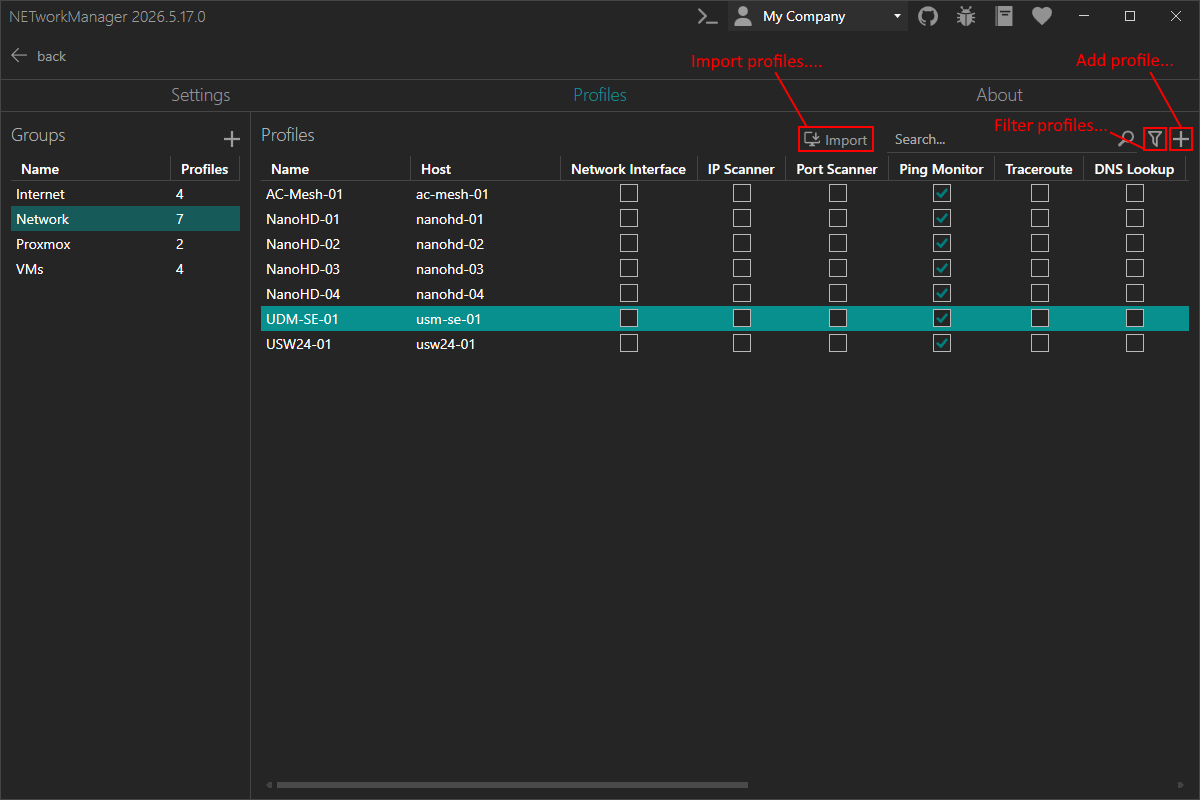
Context menu
Right-click a selected group to open the group context menu.
| Action | Description |
|---|---|
| Edit | Open the group settings dialog. |
| Delete | Delete the selected group. |
Right-click a selected profile to open the profile context menu.
| Action | Description |
|---|---|
| Edit | Open the profile settings dialog. |
| Copy | Create a copy of the selected profile. |
| Delete | Delete the selected profile. |
Keyboard shortcuts
| Key | Action |
|---|---|
F2 | Edit the selected group or profile. |
Del | Delete the selected group or profile. |
Inside a feature, the profile view shows only the groups and profiles enabled for that feature.
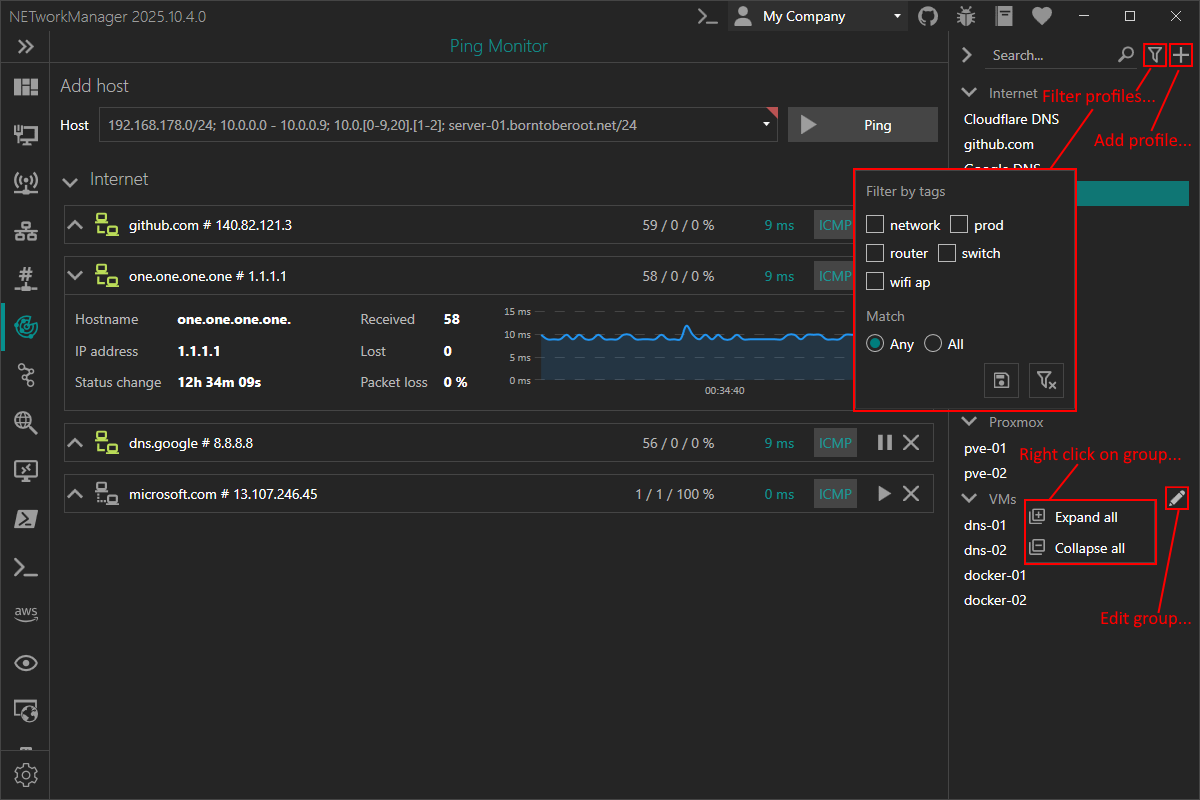
The edit button for a group appears when hovering over the group header.
Context menu
Right-click a selected profile to open the profile context menu.
| Action | Description |
|---|---|
| Edit | Open the profile settings dialog. |
| Copy | Create a copy of the selected profile. |
| Delete | Delete the selected profile. |
Right-click a group header to expand or collapse all groups.
| Action | Description |
|---|---|
| Expand all | Expand all groups. |
| Collapse all | Collapse all groups. |
Keyboard shortcuts
| Key | Action |
|---|---|
F2 | Edit the selected profile. |
Del | Delete the selected profile. |
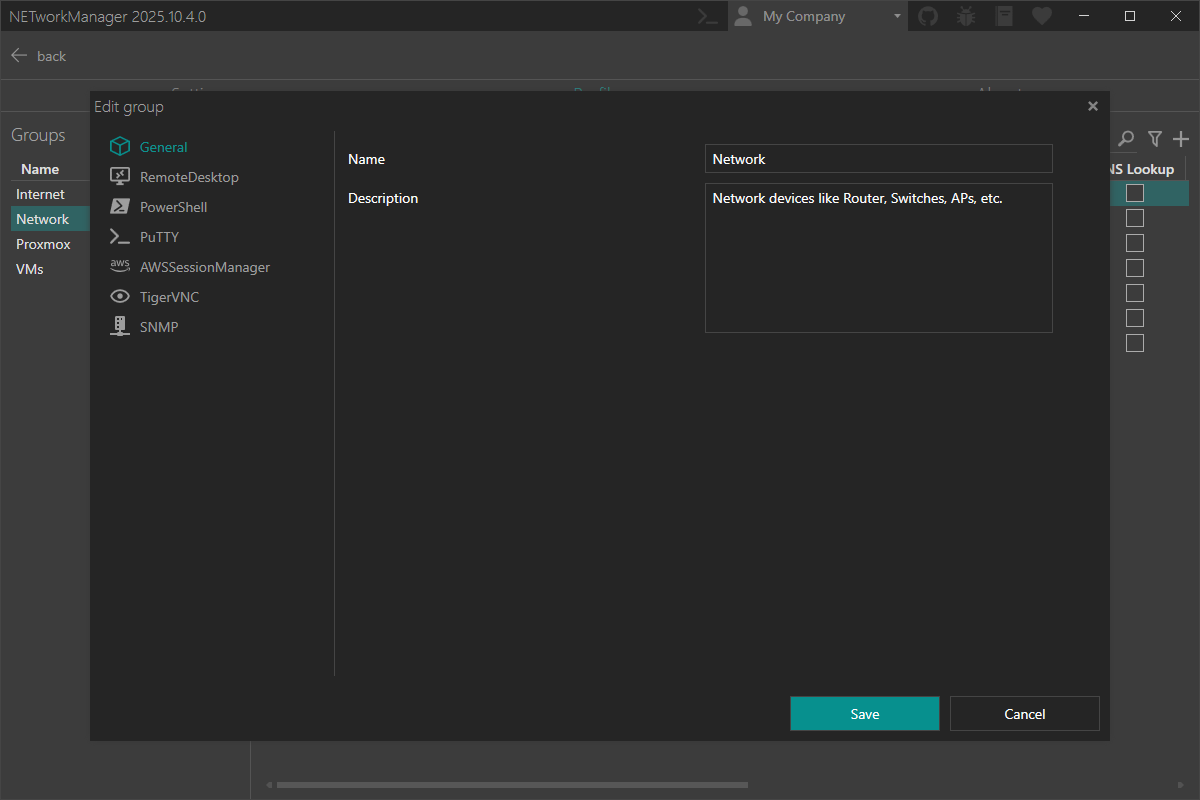
Group
In the group settings you can define general settings and feature-specific settings.
Profile
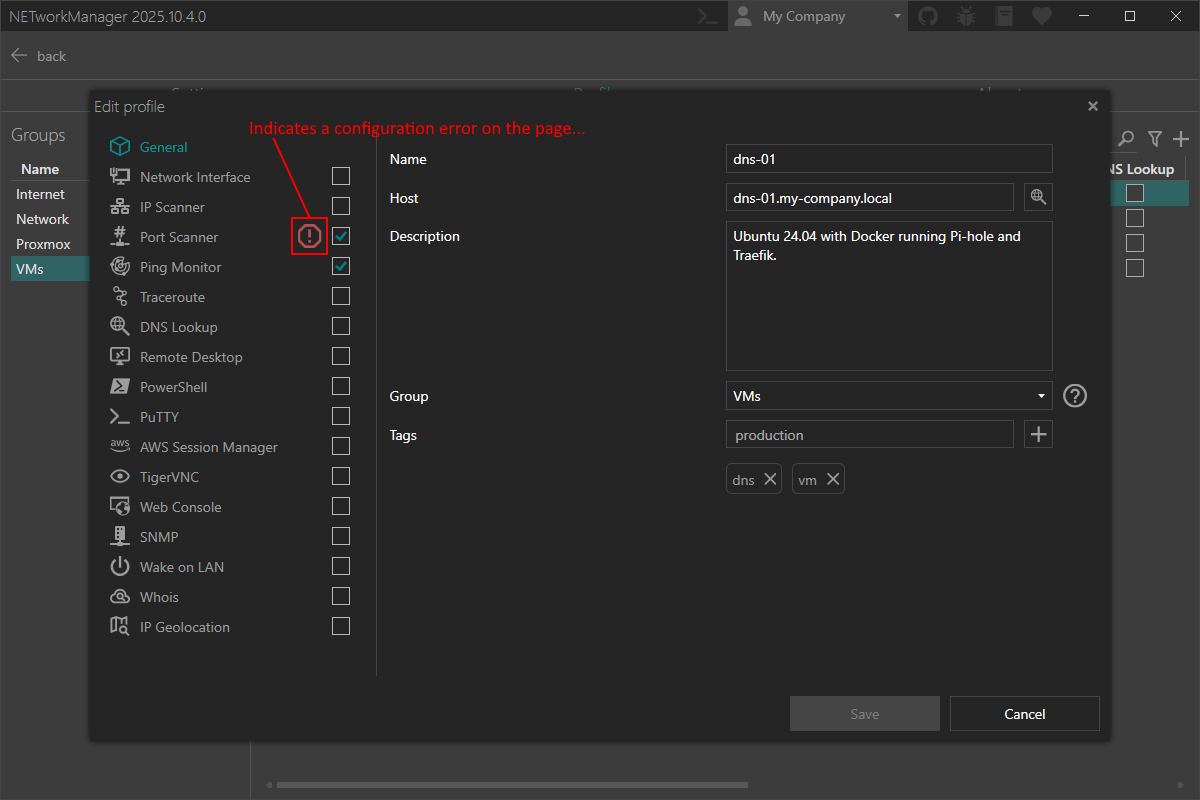
In the profile settings you can define general settings and feature-specific settings.
Profiles are only displayed in a specific feature if they have been enabled via the checkbox. The Profiles tab in Settings shows all profiles regardless.
Use tags to organize profiles and filter by them. For example, tag profiles as prod or dns to group related ones. You can filter by any or all tags.
Some settings, such as the host, can be inherited from the general settings in the feature-specific settings.
See also the profile section in the specific feature documentation for more information.
Import
Profiles can be imported from an external source. To start the import, click Import on the Profiles tab in Settings and select an import source.
The following import sources are available:
Active Directory
Profiles can be imported from Active Directory by querying computer accounts via LDAP. After selecting Active Directory as the import source, configure the connection settings and click Search.
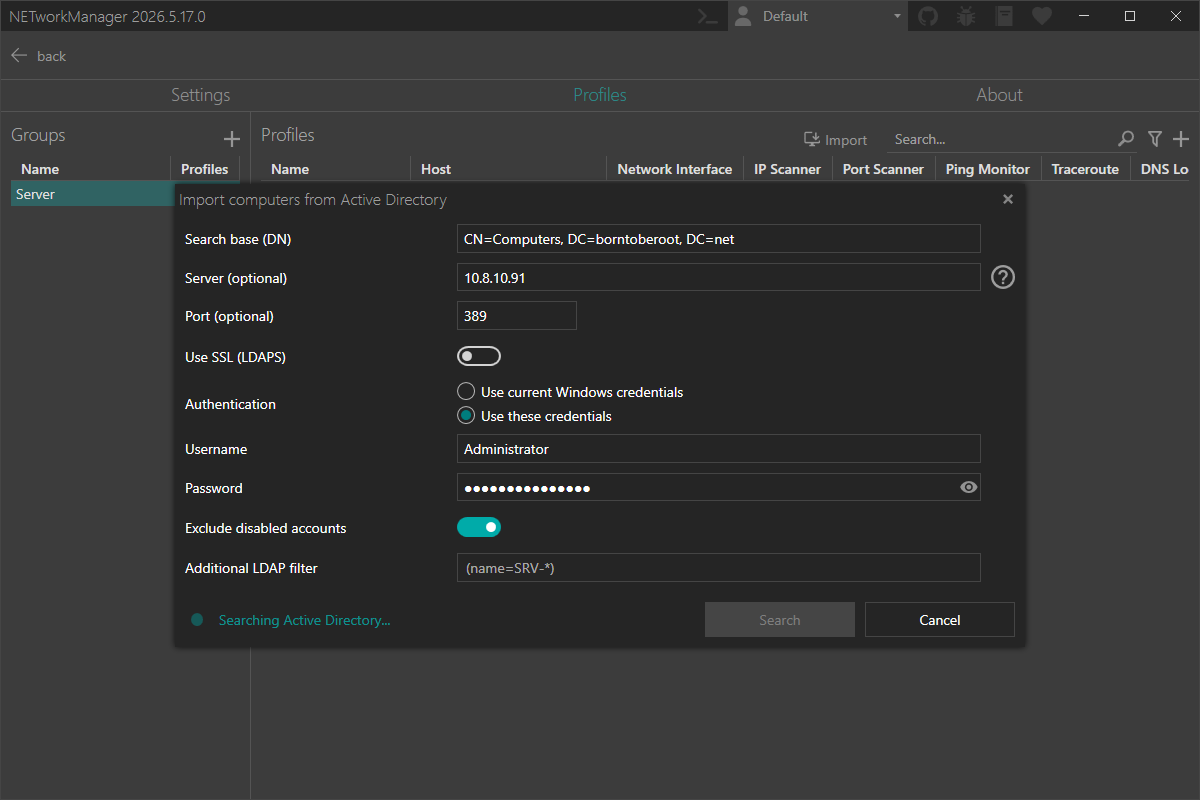
| Field | Description |
|---|---|
| Search base | LDAP search base to query, e.g. DC=domain,DC=com. |
| Server | Hostname or IP address of the LDAP server. Leave empty to use the default domain controller. |
| Port | LDAP port. Defaults to 389 (LDAP) or 636 (LDAPS). Switches automatically when Use SSL is toggled. |
| Use SSL | Connect using LDAPS (encrypted). |
| Authentication | Use current Windows credentials authenticates as the logged-in user. Use these credentials allows specifying a custom username and password. |
| Username | Username for authentication. Only available when Use these credentials is selected. |
| Password | Password for authentication. Only available when Use these credentials is selected. |
| Exclude disabled accounts | Skip computer accounts that are disabled in Active Directory. |
| Additional LDAP filter | Optional LDAP filter to narrow down results, e.g. (operatingSystem=Windows Server*). |
Once the computers are found, proceed to Review and import to select entries and configure import options.
CSV file
Profiles can be imported from a CSV file. After selecting CSV file as the import source, choose the file (drag & drop it onto the path field or click the browse button) and click Import.
| Field | Description |
|---|---|
| File path | Path to the .csv file to import. Drag & drop or browse for it. |
The expected format is one entry per line as Name;Host, with an optional third column for the description:
Name;Host;Description
Webserver;192.168.1.10;Production web server
DC01;dc01.corp.local
Router;10.0.0.1;Core router
- A header row (e.g.
Name;Host) is optional and detected automatically. - The delimiter (semicolon
;, comma,or tab) is detected automatically. - The Description column is optional. If omitted, a default description with the import date is used.
- Entries without a host are listed but cannot be imported.
- Re-importing the same file detects already imported entries (see the Status column in Review and import), based on a hash of the name and host.
Once the file is parsed, proceed to Review and import to select entries and configure import options.
Review and import
Select the entries to import and configure the options before clicking Import.
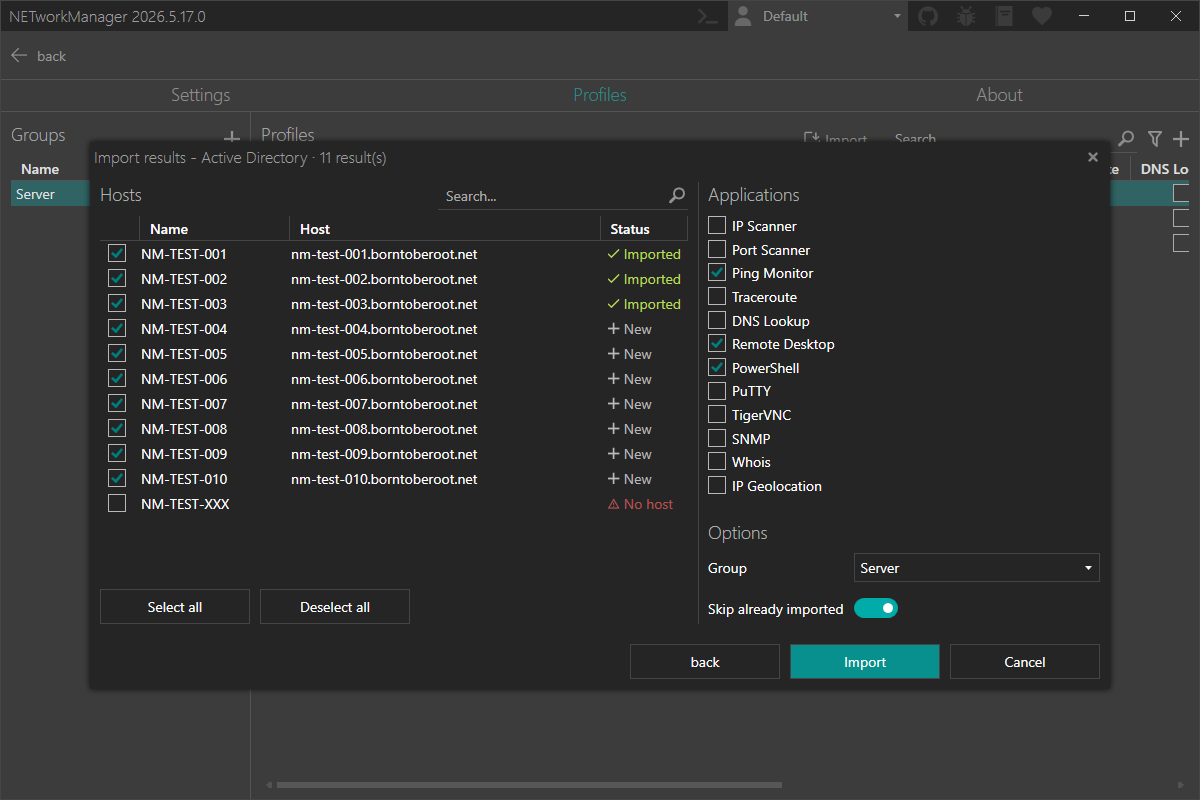
Hosts (left panel)
| Column | Description |
|---|---|
| Name | Computer name from the import source. |
| Host | Hostname used as the profile host address. |
| Status | New — not yet imported. Already imported — already exists as a profile from this source. No host — cannot be imported (no host address available). |
Applications (right panel)
Select which applications to enable for the imported profiles. Ping Monitor, Remote Desktop, and PowerShell are enabled by default.
Options (right panel)
| Field | Description |
|---|---|
| Group | Target group for the imported profiles. Select an existing group or type a new group name. |
| Skip already imported | Skip profiles that have already been imported from this source. Default is Enabled. |
After clicking Import, a summary dialog shows how many profiles were imported, how many were skipped as duplicates, and how many were skipped because no host address was available.