PowerShell with command-line applications
How do I run a command-line application in PowerShell?
You can extend the PowerShell integration of NETworkManager to run almost any command-line application — or PowerShell module — with your own configuration. Save the configuration as a profile (or apply it globally or to a group) to make it reusable across sessions.
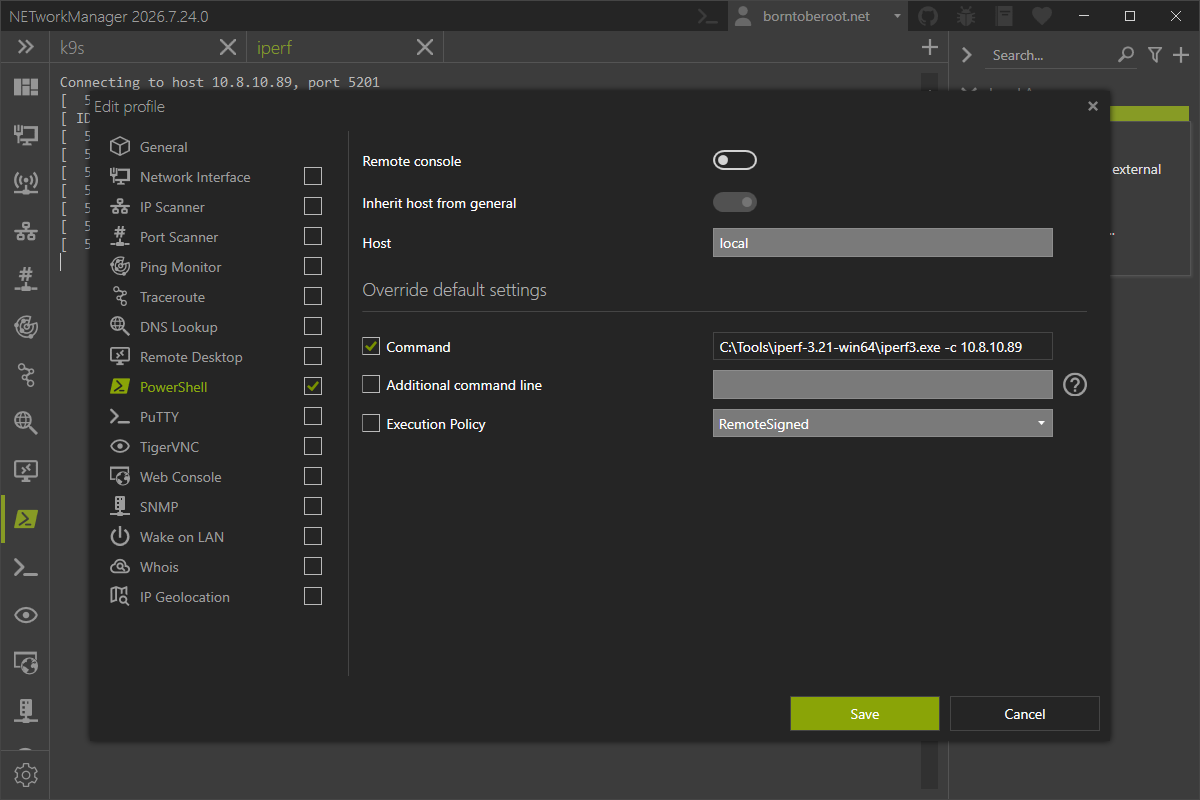
Create a new connection or profile with the following settings:
- Remote console:
False - Command:
<FilePath> <Arguments>
<FilePath> <Arguments>
This works with any application or module that can be launched from a PowerShell console — not just the examples below.
Which command-line applications can I use?
The following examples show common command-line applications that can be used with a NETworkManager PowerShell profile.
K9s
A terminal UI to interact with and manage Kubernetes clusters.
- Remote console:
False - Command:
k9s
# Use the default kubeconfig context
k9s

# Use a specific kubeconfig context with read-only mode
k9s --context <CONTEXT> --readonly

# Use a specific kubeconfig file
k9s --kubeconfig <PATH_TO_KUBECONFIG>
K9s must be installed and configured (e.g. kubeconfig) on your system.
Create a separate profile for each Kubernetes cluster by passing a specific context or kubeconfig file.
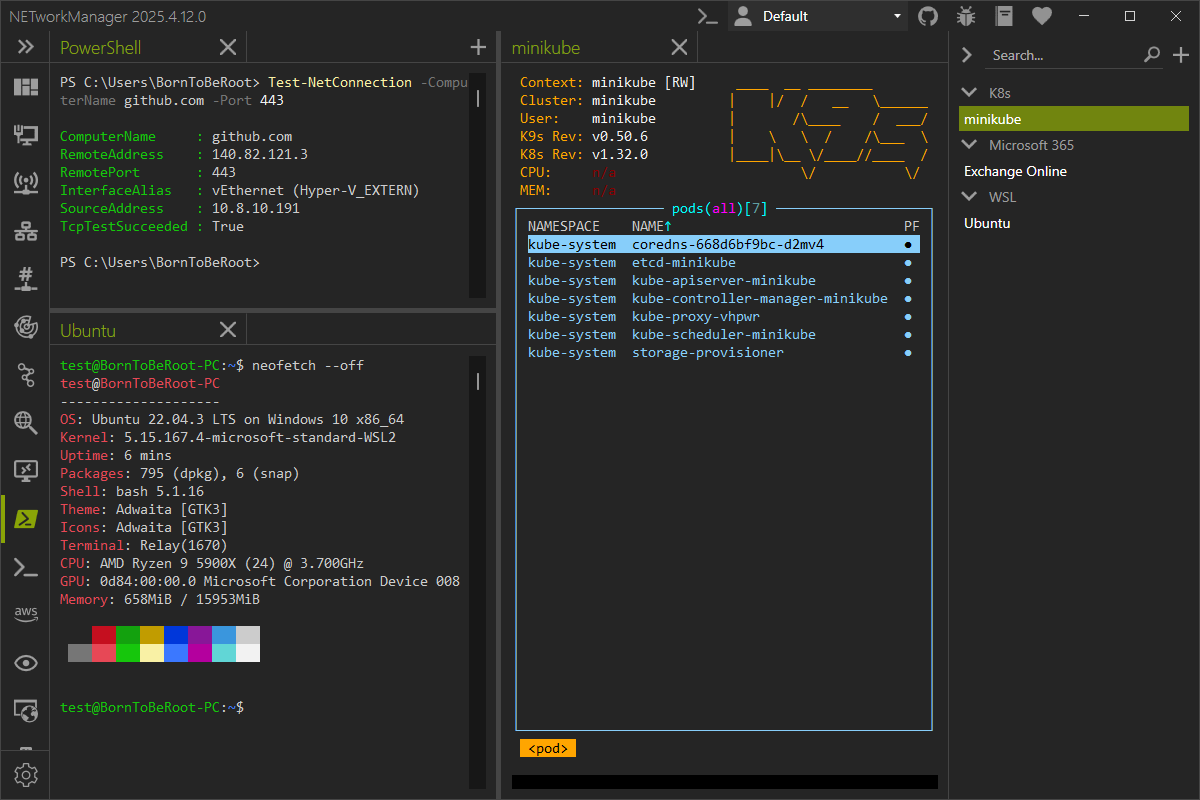
WSL (Windows Subsystem for Linux)
Run a Linux distribution directly inside a PowerShell tab.
- Remote console:
False - Command:
wsl -d <DISTRIBUTION>
wsl -d <DISTRIBUTION>
Windows Subsystem for Linux (WSL) must be installed and enabled on your system.
iPerf
Measure network throughput between two endpoints.
- Remote console:
False - Command:
iperf3 -c <SERVER>
# Run as client
iperf3 -c <SERVER>

# Run as server
iperf3 -s
iPerf3 must be installed on your system.
Exchange Online
Connect to Exchange Online to manage mailboxes and tenant settings.
- Remote console:
False - Command:
Connect-ExchangeOnline -UserPrincipalName <USER_PRINCIPAL_NAME>
Connect-ExchangeOnline -UserPrincipalName <USER_PRINCIPAL_NAME>
The ExchangeOnlineManagement PowerShell module must be installed on your system.
AWS Session Manager
Connect to an EC2 instance without opening an inbound SSH port.
- Remote console:
False - Command:
aws ssm start-session --target <INSTANCE_ID>
aws ssm start-session --target <INSTANCE_ID>
AWS CLI and the AWS Session Manager Plugin must be installed and configured to connect to EC2 instances.